A course
中文The Calibrated Eye
Opal is technically demanding, badly understood by most people who sell it, and deeply emotional for the people who buy it. That combination is why real expertise shows up fast.
Nothing here is a substitute for handling stones. It is the part you can do before the stones arrive: the words, the fields, the fakes, and the sentences that keep a customer — and you — out of trouble.
It takes about an hour. Nothing is graded, nothing is sent anywhere, and what you answer is remembered in this browser and nowhere else.
Where do you sell?
A few notes further down change with this. Nothing else does.
01
Say what you see
The distance between a clerk and a specialist is about one sentence long.
A clerk says very pretty. A specialist says N2 body tone, B4 brightness, broad flash, red on black. The second sentence is not showing off. It is the only way two people who are not holding the same stone can talk about it — on the phone, in an email, on a valuation, in an argument three years later about what was sold.
Four things, in this order, every time: body tone, brightness, pattern, dominant colour. Get into the habit of saying all four even when one of them is unremarkable, because the one you skip is the one the other person needed.
- Body tone
- How dark the background is, with the play-of-colour ignored. The Australian Opal Association’s own test is to squint at the face of the stone until the colours drop away and only the ground is left, then match that against the N-scale. N1–N4 is black opal; N5–N6 dark; N7–N9 light, with N9 called white. Only a natural solid stone in the N1–N4 band may be called black opal — not a doublet, not a treated matrix, however black it looks.
- Brightness
- How strong the colour is in ordinary light, judged face-up from about a foot away. Usually B1–B5, and — this matters — the scale is not standardised the way body tone is. Most Australian usage runs B1 subdued to B5 vivid; some houses use B1–B7 with B1 the brightest. Say which way you are counting, every time. Getting this backwards in front of a dealer is the single fastest way to be read as new.
- Pattern
- The shape the colour takes across the face: pinfire, broad flash, rolling flash, Chinese writing, harlequin. Patterns are named for what they look like and priced for how rare they are.
- Dominant colour
- Which colour leads. Red is rarest, then orange, gold, green, blue — the order follows the size of the silica spheres doing the diffracting, and large spheres in an even lattice are hard to come by. Blue-green on a light body is the floor of the market. Red on black is the ceiling.
Drag the stone to turn it under the light
A stone squints out at N3, and the colour is a strong even green across the whole face that lights up all at once. What do you call it?
Show the answer
Black opal, N3 body tone, broad flash, green dominant
N3 is inside the N1–N4 band, so it is a black opal, not a dark one. Colour that fills the face and lights together is a broad flash. And N is a body tone, never a brightness — mixing the two letters up is the mistake to never make twice.
N3 is inside the N1–N4 band, so it is a black opal, not a dark one. Colour that fills the face and lights together is a broad flash. And N is a body tone, never a brightness — mixing the two letters up is the mistake to never make twice.
A dealer emails you: “N2, B2, pinfire, blue.” You have not seen it. What have you been told?
Show the answer
A black-bodied stone whose colour is weak, in the commonest pattern and the commonest colour
The body tone is excellent and everything after it is not: on the usual B1–B5 reading, B2 is subdued, pinfire is the commonest pattern and blue the commonest colour. A dark ground alone does not make a stone. Worth one more email, though — if that dealer is on a B1–B7 scale, B2 means brilliant, and you have just been offered something rather different.
The body tone is excellent and everything after it is not: on the usual B1–B5 reading, B2 is subdued, pinfire is the commonest pattern and blue the commonest colour. A dark ground alone does not make a stone. Worth one more email, though — if that dealer is on a B1–B7 scale, B2 means brilliant, and you have just been offered something rather different.
02
Where it came from, and what that means
Origin is not trivia. It predicts value, durability and the care conversation, and it is the part customers actually want to hear.
Learn these six well enough to place a stone in the right one from across the counter, then learn the reasons behind each. Every one of them behaves differently in the hand, in the setting, and in the wash-up bowl.
Where it actually comes from
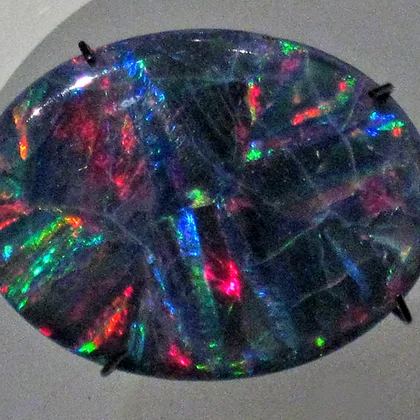
Black opal
Lightning Ridge
New South Wales, Australia
The only field producing true black opal in quantity. Colour sitting on a ground of its own darkness, cut solid, N1–N4. Everything expensive in opal comes from here or is compared to it. Mintabie in South Australia produced some black material too, and the field is now closed.
- Wear
- Solid stone, usually a good dome. Wears as well as opal wears — which is to say, respect it.
- Money
- The top of the market by a distance.
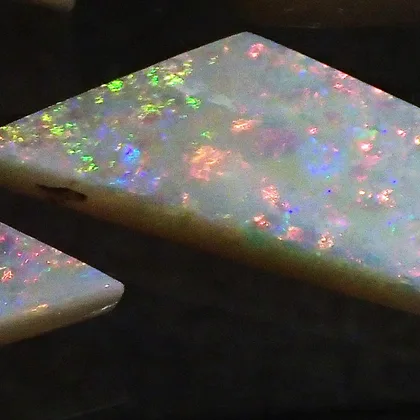
Light and white opal, crystal
Coober Pedy
South Australia
The volume of the trade, and most people’s first opal. Light body tone, N7–N9, cut solid out of seam. Brightness is what separates a fifty-dollar stone from a five-thousand-dollar one here, because body tone cannot.
- Wear
- Solid, but seam material is often cut thin and flat. Check the profile.
- Money
- Affordable at the bottom, genuinely valuable at the top of the brightness scale.
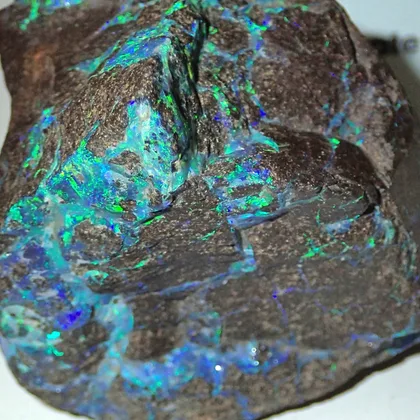
Boulder opal
Queensland boulder
Winton, Quilpie, Yowah, Koroit
A skin of precious opal formed in and on ironstone, cut with the host rock still attached. Because the ironstone stays, the stone gets a dark backing that nature put there — it is a solid opal, not a doublet, and saying so clearly is part of the job. Cut freeform, following the seam.
- Wear
- The most robust opal on the counter. The ironstone carries the thin colour layer and takes the knocks.
- Money
- Wide range. Fine Winton and Koroit material is not cheap.
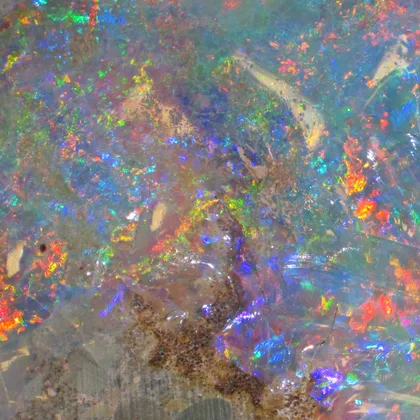
Matrix opal, and fine crystal
Andamooka
South Australia
Porous limestone and sandstone with opal in the voids. Left alone it is pale and dull; the black-bodied Andamooka matrix in every case in the country has been through a sugar-and-acid treatment that precipitates carbon in the pores. That treatment is traditional, accepted, and permanent — and it is a treatment, so it goes on the receipt. Andamooka also produced superb solid crystal opal.
- Wear
- Treated matrix is porous. Keep it away from solvents and oils.
- Money
- Modest, and honest about it.
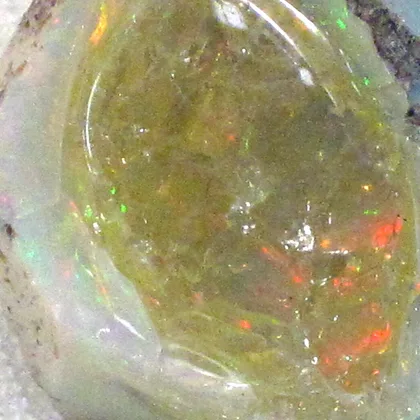
Hydrophane precious opal
Wollo (Welo)
Delanta and Wegel Tena, Ethiopia
On the market in quantity since 2008 and now the brightest opal most customers have ever seen for the money. It also behaves unlike anything Australian: it drinks. That is a whole chapter, further down, and it is not optional reading.
- Wear
- Hydrophane. Absorbs water, oils and dye; more prone to crazing; never near an ultrasonic.
- Money
- Extraordinary brightness per dollar. Price the risk in honestly rather than pretending it away.
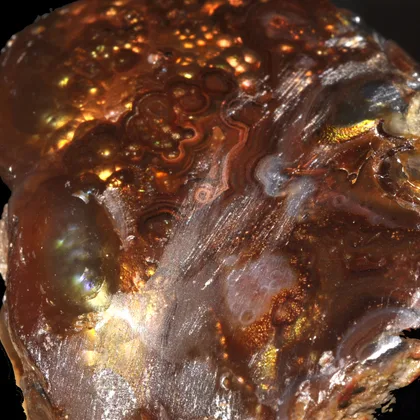
Fire opal
Querétaro and Jalisco
Mexico
A different conversation entirely. Fire opal is named for its body colour — yellow through orange to red, from traces of iron — and not for play-of-colour, which it may have a little of or none at all. It is often transparent enough to facet, which no Australian opal is.
- Wear
- Faceted stones have edges and corners to chip. Some Mexican material crazes.
- Money
- Priced on body colour, clarity and size, like a coloured stone rather than like opal.
And the names behind those
- Brazil (Pedro II, Piauí) — light and crystal opal, often mistaken for Australian.
- Peru — blue and pink common opal, no play-of-colour at all. A lovely material sold under a confusing name.
- Honduras — precious opal in black basalt, a natural black matrix.
- Virgin Valley, Nevada — some of the most beautiful opal ever found, and notoriously prone to crazing as it dries. Usually sold in water.
The stones on this pageTeaching specimens, not stock. None of these belong to Michelle Yuen Jewelry and none are for sale. Photographs by James St. John (CC BY 2.0) and Géry Parent (public domain), via Wikimedia Commons. Cropped. Coastlines, borders and state boundaries from Natural Earth, public domain. Simplified; plate carrée.
A customer brings in a freeform stone: bright colour on a dark ground, with brown ironstone visible on the back and up one side. Is it a doublet?
Show the answer
No — it is a solid boulder opal, with its own host rock still attached
Queensland boulder opal forms as a thin skin of colour in and on ironstone, and it is cut with the host still attached. There is no glue and no second material — it is one piece out of the ground, and it is a solid opal. It also happens to be the toughest opal you will handle, because the ironstone carries the thin colour layer.
Queensland boulder opal forms as a thin skin of colour in and on ironstone, and it is cut with the host still attached. There is no glue and no second material — it is one piece out of the ground, and it is a solid opal. It also happens to be the toughest opal you will handle, because the ironstone carries the thin colour layer.
03
One piece, or three
Turn the stone side-on. Almost everything you need is at the girdle.
A doublet is a slice of opal glued to a dark backing. A triplet adds a clear cap over the top, so the dome you admire is quartz or glass and the opal is a wafer underneath it. Both are legitimate, both let people own opal they could not otherwise afford, and neither is a fake — until somebody sells one without saying which it is.
The examination is always the same: take it out of the light box, turn it ninety degrees, and look at the edge under ten times magnification. A solid stone has a continuous dome. A doublet has one dead-straight line. A triplet has two.
The trap is a rubover bezel that covers the girdle all the way round. With the edge hidden, a doublet can defeat an expert. When that is the situation, you do not guess — you ask the supplier in writing, and you keep the answer.
One stone all the way through.
- From the side
- A continuous dome. Body tone, potch and colour are all the same piece of material, and the back is opal or its natural host.
- Tells
- Irregular back. Colour that changes as the stone thins towards the edge. Potch lines and sand running through it.
A slice of opal glued to a dark backing.
- From the side
- A dead-straight line at the girdle where the two layers meet. The backing may be potch, ironstone, black glass or plastic.
- Tells
- A flat base and a shallow, even dome. That straight join under a loupe from the side. Colour that stops abruptly at the rim.
A slice of opal between a dark base and a clear cap.
- From the side
- Three bands. The dome you are looking at is the cap — quartz, glass or plastic — not the opal, which is a wafer in the middle.
- Tells
- A perfect, glassy, machine-regular dome. Two straight lines at the girdle. Under magnification the cap can show a fine “lizard skin” texture. Colour magnified beyond what the wafer could really carry.
A stone has a flawless, perfectly regular glassy dome and a colour layer that seems astonishingly bright for the price. What is your first thought?
Show the answer
Triplet — the dome is a cap and it is magnifying a wafer
Nature does not polish that evenly and neither do most cutters. A machine-regular dome, a glassy feel and colour brighter than the money should buy is the standard triplet signature; the cap magnifies a very thin slice of opal. Confirm it at the girdle before you say so out loud.
Nature does not polish that evenly and neither do most cutters. A machine-regular dome, a glassy feel and colour brighter than the money should buy is the standard triplet signature; the cap magnifies a very thin slice of opal. Confirm it at the girdle before you say so out loud.
You are certain a ring in your own case is a doublet. The supplier’s invoice says only “Australian opal”. What do you do?
Show the answer
Sell it as a doublet and note the discrepancy back to the supplier in writing
Whatever the invoice says, the receipt with your shop’s name on it is the document a customer will produce in three years. Describe what is actually in the ring, and put the query to the supplier in writing so there is a record of when you raised it. This is not primarily an ethics point — it is the cheapest insurance you will ever buy.
Whatever the invoice says, the receipt with your shop’s name on it is the document a customer will produce in three years. Describe what is actually in the ring, and put the query to the supplier in writing so there is a record of when you raised it. This is not primarily an ethics point — it is the cheapest insurance you will ever buy.
04
The reference tray
Buy a cheap example of every one of these and keep them in a tray by the loupe. You cannot learn to spot fakes from photographs — including the photographs on this page.
The point of the tray is not the individual stones. It is that after a few months of picking them up next to the real thing, your hand starts telling you before your eye does — the plastic is too warm, the glass is too cold, the synthetic is too even. That is what a calibrated eye actually is, and it is not built by reading.
Smoke treatmentPorous opal wrapped and heated until carbon soot is driven into the surface, darkening the ground and lifting the colour.
- How to spot it
- The darkening is a surface layer — look at the back and at any chip. Common on Ethiopian material.
- What to call it
- A treatment. Disclose it.
Sugar and acidSoaked in sugar solution, then in sulphuric acid; carbon precipitates in the pores and blackens the ground from within.
- How to spot it
- Dark specks concentrated in the porous matrix under magnification. The classic treatment for Andamooka matrix, and centuries old.
- What to call it
- A treatment. Traditional, permanent, accepted — and still disclosed.
DyePorous opal — Ethiopian especially — takes coloured dye readily, most often to fake a black or a “chocolate” body.
- How to spot it
- Colour pooling in cracks and pores rather than sitting evenly. An unnaturally uniform ground.
- What to call it
- A treatment, and the one most often left unsaid.
Resin and polymerImpregnation with Opticon or similar to fill cracks, raise transparency and hold fragile material together.
- How to spot it
- A slightly plasticky lustre; a hot point smell; filled fractures that look glassy rather than open.
- What to call it
- A treatment, and one that changes how the stone should be cleaned.
Gilson syntheticActual opal, grown rather than mined — Pierre Gilson brought it to market in 1972 by settling uniform silica spheres over months and consolidating them.
- How to spot it
- Colour patches with a snakeskin or chicken-wire outline; a columnar structure when a thick stone is viewed from the side; a regularity nothing in the ground ever achieves.
- What to call it
- Synthetic. Never “opal” unqualified.
Slocum stoneGlass with crumpled metal foil suspended in it, made by John Slocum from the early 1970s. Not opal in any sense.
- How to spot it
- The “colour” is sheets of foil — you can see the crinkles. Gas bubbles. It is glass: cold, heavy, and it rings.
- What to call it
- An imitation.
Opalite and “sea opal”Manufactured milky glass. It has a soft blue-orange glow from opalescence, and no play-of-colour whatsoever.
- How to spot it
- Move it. Nothing happens. That is the whole test.
- What to call it
- An imitation, sold as opal constantly and usually not by anyone who knows better.
PlasticResin with interference flakes, used in cheap inlay and souvenir work.
- How to spot it
- Warm to the touch, light in the hand, soft enough to mark with a pin in a hidden place.
- What to call it
- An imitation.
A bright blue-and-orange “opal” bead shows a soft glow that shifts with the light but never breaks into separate patches of colour. What is it?
Show the answer
Opalite — manufactured glass, with opalescence and no play-of-colour
Opalescence and play-of-colour are two different phenomena, and the difference is the whole test. Opalescence is a milky glow from light scattering; play-of-colour is diffraction, and it breaks into discrete patches that come and go as you move the stone. If nothing separates and nothing switches off, there is no lattice in there.
Opalescence and play-of-colour are two different phenomena, and the difference is the whole test. Opalescence is a milky glow from light scattering; play-of-colour is diffraction, and it breaks into discrete patches that come and go as you move the stone. If nothing separates and nothing switches off, there is no lattice in there.
05
The stone that drinks
This is the single most common source of an unhappy opal customer, and almost all of it is preventable with one sentence said before the sale.
Ethiopian Wollo opal is hydrophane: porous enough to take liquid into its structure. Put it in water and it gains measurable weight — GIA has reported figures in the range of about five to thirteen per cent, varying within a single piece because the porosity is uneven — and it changes appearance, usually going more transparent and losing its play-of-colour while it is wet. Left alone it dries out and comes back, over hours or days.
That is the good case. The bad cases are the ones that do not come back. It absorbs hand cream, perfume, sunscreen, cooking oil and dyed water, and some of that stays. It is more prone to crazing — fine surface fracturing — than Australian material, especially with fast wetting and drying. And an ultrasonic cleaner does not clean a hydrophane opal; it forces detergent into it.
None of this makes Ethiopian opal a bad stone. It is the brightest opal most of your customers will ever be able to afford, and sold honestly it makes people very happy. What ruins it is discovering the behaviour after the purchase, in a bathroom, alone. Say it first, plainly, and say it again on the receipt.
A diagram, not a photograph. Real behaviour varies from piece to piece — the porosity is uneven even within one stone.
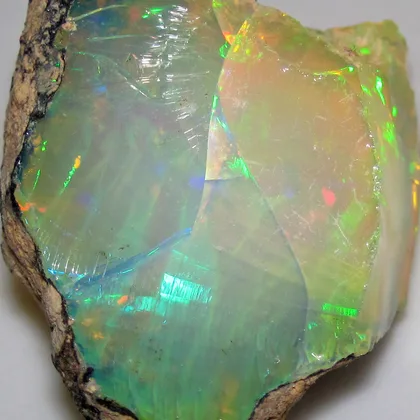
A customer rings in a panic: the Welo opal she bought last month has gone cloudy and dull after she washed her hands. What do you tell her?
Show the answer
That is the hydrophane behaviour we talked about. Leave it somewhere dry and out of the sun; it should come back over the next few days. Ring me if it has not.
It is doing exactly what that material does, and it usually recovers on its own. Slow and dry is the whole treatment — heat is the one thing that turns a temporary cloudiness into permanent crazing. The words “we talked about” are doing the real work in that sentence, though, and they only exist if you actually did.
It is doing exactly what that material does, and it usually recovers on its own. Slow and dry is the whole treatment — heat is the one thing that turns a temporary cloudiness into permanent crazing. The words “we talked about” are doing the real work in that sentence, though, and they only exist if you actually did.
06
Papers
Two different things are worth having: something specific to opal, and something broad enough to cover the rest of your counter.
Formats, prices and even the existence of individual courses change from year to year. Everything below carries the date it was checked, and every one of them links to the source. Go and look before you spend anything.
GAA Certificate in Opal Studies
Gemmological Association of Australia, with the Australian Opal Centre
The most opal-specific qualification that exists. Eleven modules — science, formation, opalised fossils, mining, processing, valuation, buying, care, ethics — entirely online and self-paced, with no prerequisites. If you only ever do one thing on this list, do this one.
A$550, or A$495 for GAA and AOC members; twelve months’ access (checked August 2026).
Australian Opal Centre
Lightning Ridge, New South Wales
The research collection and the practical studies, at the field itself, in the new facility that opened in 2025. Nothing you can read replaces a week where the stones come out of the ground.
Varies by programme.
GIA Graduate Gemologist
Gemological Institute of America
The broad credential — diamonds and coloured stones, lab practicals, instrument work. It will not make you an opal specialist, but it is what gives you standing across the rest of the counter, and it is the qualification most of the world recognises on sight.
Check GIA directly; format and price vary by campus and by year.
Gem-A Foundation, then the Gemmology Diploma (FGA)
Gemmological Association of Great Britain
The British route to the same breadth, and the stronger of the two on laboratory practicals. FGA after your name carries real weight in the UK, Europe and much of Asia.
Varies with where the practical tuition and exams are sat.
GIA Colored Stone Essentials
Gemological Institute of America
A short course, and a reasonable entry point in a year when the full diploma is out of reach. It will not cover opal in any depth — take it for the vocabulary and the habits, not the stone.
Check GIA directly.
07
The other half of the job
This is where most people underinvest, and it is where a specialist is actually made.
Match the stone to the life, not just to the budget. Opal runs 5.5–6.5 on the Mohs scale and dislikes both knocks and thermal shock. Somebody who wants a daily-wear engagement ring and works with their hands needs a bezel, a low profile, and ideally boulder opal with ironstone behind it — or, said kindly and early, a pendant instead. Talking a person out of the wrong purchase builds more business over ten years than closing it does today.
Own the care conversation, and hand it over in writing. Customers remember who warned them. They remember it especially clearly on the day something goes wrong, which is the day you would most like to be remembered accurately.
Handle the superstition, because it is coming. Someone will ask whether opals are bad luck. They are not, and the belief has a birthday. Sir Walter Scott published Anne of Geierstein in 1829; in it the Lady Hermione wears an opal that flares and dims with her moods, until holy water is sprinkled on it, the stone throws one bright spark and goes dead as a pebble, and by morning she is a small heap of ashes. Before that novel there is no European tradition of opal as unlucky at all — the Romans prized it, the Habsburgs collected it, and seventeenth-century writers like Anselmus de Boodt and Robert Boyle wrote about it with admiration. (You will also hear that European opal sales halved after publication. That figure is trade folklore with no source behind it; tell the story, not the statistic.) Thirty seconds, told well, turns the most common objection you will ever hear into the moment the customer decides they like you.
Sell the provenance. Nobody has ever fallen in love with “N2, B4”. They fall in love with the field, the depth it came from, the person who cut it, and the fact that this particular arrangement of colour happened once and will not happen again. Learn where each stone in your case came from. That is what closes.
Disclose everything, always, in writing. Doublet or triplet. Any treatment. Hydrophane behaviour. Any crazing you know about. On the receipt, not only in conversation. Ethics and self-defence turn out to be the same document.
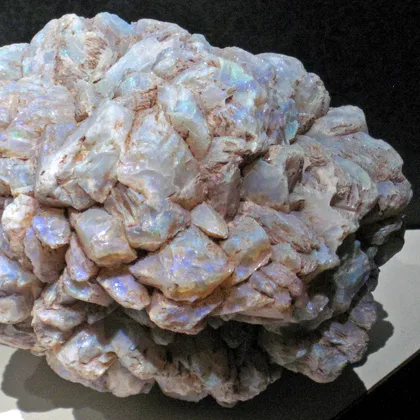
The card you hand over
- Opal is 5.5–6.5 on the Mohs scale. It does not like knocks, and it likes sudden temperature changes even less.
- Never an ultrasonic cleaner. Never steam. Never boiling water.
- Warm water, a little mild soap, a soft cloth. Keep the water close to room temperature.
- If your stone is a doublet or a triplet, do not soak it at all — water gets into the glue. Wipe it with a barely damp cloth.
- Off before the pool, the shower, the washing-up, the gym, the garden.
- Away from bleach, chlorine, solvents, perfume and hand cream — and on last, after the perfume has dried.
- Store it away from harder stones so nothing scratches it, and out of a hot car or a sunny windowsill.
- If it ever needs resizing, the stone comes out first.
“Aren’t opals bad luck?”
Show the answer
“It comes from a novel, actually — Walter Scott, 1829. There’s an opal in it that goes dead when holy water touches it, and the woman wearing it turns to ashes. It was a bestseller, and the idea stuck. Before that book nobody in Europe thought anything of the sort — the Romans loved opal.”
The first answer is true and closes the conversation. The third quietly concedes the premise. The second is the only one that gives them something to repeat at dinner — and a customer who leaves with a story tells other people about your shop.
The first answer is true and closes the conversation. The third quietly concedes the premise. The second is the only one that gives them something to repeat at dinner — and a customer who leaves with a story tells other people about your shop.
“My daughter wants an opal engagement ring. She’s a nurse.”
Show the answer
“Then let’s find one that can take it — a bezel setting, low to the finger, and I’d steer you towards boulder opal with the ironstone behind it. And she should take it off for handwashing, which for a nurse is worth thinking about honestly before we choose.”
The third answer sells a ring that comes back damaged. The second is correct and useless — it refuses the sale without offering anything. The first takes the request seriously, solves the durability problem with a setting and a material, and raises the real obstacle before the money is spent rather than after.
The third answer sells a ring that comes back damaged. The second is correct and useless — it refuses the sale without offering anything. The first takes the request seriously, solves the durability problem with a setting and a material, and raises the real obstacle before the money is spent rather than after.
“Why is this one two hundred dollars and that one four thousand? They look the same to me.”
Show the answer
“Hold them both under the light and turn them. This one’s body tone is N7 — light ground — and the colour is a blue-green pinfire. That one is N2, near black, and the flash is red. Red on black is the rarest thing opal does. Once you’ve seen the two side by side you won’t unsee it.”
Never assert a price difference — demonstrate it, with both stones in their hands and the vocabulary attached to what they are looking at. You have also just taught them to see it, which is the thing that makes them come back to you rather than to a screen.
Never assert a price difference — demonstrate it, with both stones in their hands and the vocabulary attached to what they are looking at. You have also just taught them to see it, which is the thing that makes them come back to you rather than to a screen.
“It’s an inlay piece I inherited. Can I just put it in with my rings when you clean them?”
Show the answer
“Not this one. Inlay is glued in, and so is anything with a doublet or triplet in it — an ultrasonic gets into the adhesive. And even solid opal shouldn’t go near one. I’ll do it by hand while you wait.”
The third answer protects you and teaches nothing. The second gives the reason, covers the general rule and the specific one, and replaces the refusal with an offer — which is what turns a no into a reason to come back.
The third answer protects you and teaches nothing. The second gives the reason, covers the general rule and the specific one, and replaces the refusal with an offer — which is what turns a no into a reason to come back.
A wholesaler’s listing reads “genuine Australian opal, 8×6mm oval, black”. The photograph shows a flat-based stone with an even shallow dome. What do you ask?
Show the answer
“Is it a solid, a doublet or a triplet? Please confirm in writing.”
“Genuine Australian opal” is true of the opal layer in a doublet, which is precisely why the phrase gets used that way. A flat base with an even shallow dome at a black-opal size and a non-black-opal price is worth one direct question. Body tone matters too — but only once you know how much stone is actually there.
“Genuine Australian opal” is true of the opal layer in a doublet, which is precisely why the phrase gets used that way. A flat base with an even shallow dome at a black-opal size and a non-black-opal price is worth one direct question. Body tone matters too — but only once you know how much stone is actually there.
08
How specialists actually get made
Volume, a notebook, and being the person everyone asks.
Handle stones every single day. A ten-times loupe and a darkfield light, and go through everything in the case — not only the piece a customer is looking at. Note what you see: dome height, quality of cut, potch lines, sand inclusions, whether the colour survives being tilted away from the light. Photograph the inventory. A calibrated eye is built out of repetitions, and there is no shortcut that skips them.
Keep a notebook of every stone you sell. What it was, in the full four-part description. Who bought it. Why they chose that one over the other two you showed them. Within a year it is your portfolio; within two it is the reason someone lets you go on a buying trip; forever after it is the best customer record in the shop.
Get to a show. Tucson is the big one, spread across the city in late January and early February — AGTA GemFair runs 31 January to 4 February 2027 and the Tucson Gem & Mineral Show itself 11 to 14 February 2027. If you can reach Australia, the Lightning Ridge Opal Festival is held in the town at the end of July, and the Australian Opal Association keeps a circuit of smaller shows worth working through.
Ask to sit in on the buying. Not to choose — to watch what your buyer rejects and why. That is where the calibration you cannot get from a course happens.
Volunteer for the unglamorous jobs. Offer to write the shop’s care cards, and to train new staff on opal. Specialists are not appointed. They are the person everybody has got into the habit of asking.
09
The bench
Nine questions, drawn from everything above. Nothing is sent anywhere.
Which of these may correctly be described as “black opal”?
Show the answer
A natural solid opal with a body tone of N1 to N4
The term is defined by the Australian Opal Association and it is narrow on purpose: a natural solid stone, N1–N4. A composite may look blacker than any of them and still cannot be called black opal — the words describe what the stone is, not what it looks like.
The term is defined by the Australian Opal Association and it is narrow on purpose: a natural solid stone, N1–N4. A composite may look blacker than any of them and still cannot be called black opal — the words describe what the stone is, not what it looks like.
A supplier describes a parcel as “B1”. What should you do before quoting on it?
Show the answer
Ask which way their brightness scale runs
Body tone is standardised; brightness is not. Most Australian usage runs B1 subdued to B5 vivid, but the B1–B7 scale runs the other way with B1 the brightest. Both are in daily use. Asking costs nothing; assuming costs the difference between the two ends of a parcel.
Body tone is standardised; brightness is not. Most Australian usage runs B1 subdued to B5 vivid, but the B1–B7 scale runs the other way with B1 the brightest. Both are in daily use. Asking costs nothing; assuming costs the difference between the two ends of a parcel.
Which pattern is rarest, and therefore most often claimed for stones that do not have it?
Show the answer
Harlequin
True harlequin is angular blocks of colour with their edges actually touching, across the face of the stone. A couple of square patches in one corner is not harlequin, and calling it that is how a reputation goes.
True harlequin is angular blocks of colour with their edges actually touching, across the face of the stone. A couple of square patches in one corner is not harlequin, and calling it that is how a reputation goes.
You see two straight parallel lines at the girdle under a loupe. What is in your hand?
Show the answer
A triplet
One straight join is a doublet: opal on a backing. Two is a triplet: a dark base, a wafer of opal, and a clear cap on top — and it is the cap you have been admiring, not the opal.
One straight join is a doublet: opal on a backing. Two is a triplet: a dark base, a wafer of opal, and a clear cap on top — and it is the cap you have been admiring, not the opal.
Andamooka matrix opal with a rich black ground has almost always been —
Show the answer
sugar-and-acid treated, which must be disclosed
Untreated Andamooka matrix is pale and dull. The sugar-and-acid process precipitates carbon in the pores and blackens it from within; the treatment is traditional, permanent and entirely accepted. What is not acceptable is failing to write it on the receipt.
Untreated Andamooka matrix is pale and dull. The sugar-and-acid process precipitates carbon in the pores and blackens it from within; the treatment is traditional, permanent and entirely accepted. What is not acceptable is failing to write it on the receipt.
Which is safe for a solid opal ring?
Show the answer
Warm — not hot — water, mild soap and a soft cloth
Ultrasonic and steam are both out: opal dislikes vibration, and it dislikes sudden temperature change more. Warm soapy water and a soft cloth is the whole method. Doublets and triplets do not even get that — wipe them, never soak them, because water finds the glue.
Ultrasonic and steam are both out: opal dislikes vibration, and it dislikes sudden temperature change more. Warm soapy water and a soft cloth is the whole method. Doublets and triplets do not even get that — wipe them, never soak them, because water finds the glue.
A customer’s Ethiopian opal has turned transparent and lost its colour after a swim. The most likely outcome is —
Show the answer
it dries out over hours or days and returns to normal
Hydrophane opal takes water into its structure and gives it back. Somewhere dry, out of direct sun and away from heat, and it usually recovers completely. What it must not get is a fast dry — that is how a temporary cloudiness becomes permanent crazing. Chlorinated water is a separate worry worth mentioning.
Hydrophane opal takes water into its structure and gives it back. Somewhere dry, out of direct sun and away from heat, and it usually recovers completely. What it must not get is a fast dry — that is how a temporary cloudiness becomes permanent crazing. Chlorinated water is a separate worry worth mentioning.
Colour patches with a snakeskin outline, and a columnar structure visible from the side. What is it?
Show the answer
Gilson synthetic opal
That is the Gilson signature: real opal chemistry, grown from settled silica spheres, and far too regular. Slocum stone is glass with crumpled metal foil in it — the “colour” is visibly sheets, not patches.
That is the Gilson signature: real opal chemistry, grown from settled silica spheres, and far too regular. Slocum stone is glass with crumpled metal foil in it — the “colour” is visibly sheets, not patches.
Where does the belief that opals are unlucky come from?
Show the answer
Sir Walter Scott’s novel Anne of Geierstein, 1829
One novel, and a popular one. Pliny in fact wrote admiringly of opal, and there is no significant pre-1829 European text treating it as unlucky. Knowing the date and the plot turns the objection into the best half-minute of the sale.
One novel, and a popular one. Pliny in fact wrote admiringly of opal, and there is no significant pre-1829 European text treating it as unlucky. Knowing the date and the plot turns the objection into the best half-minute of the sale.